

The Blood That Bought Us: A Good Friday Reflection

And almost all things are by the law purged with blood; and without shedding of blood is no remission.
Hebrews 9:22 (KJV)
Blood is at the center of the story of redemption. To understand why, we have to go to the Exodus of it all, the blood of atonement, and even before that, we go further back to Genesis, where sin first rears its head and introduces death as its wages. For death to occur, life must be taken. Blood represents life and death, and when blood is shed, it testifies that life has been given up.
Once sin entered, man stood under the sentence of death. Justice required that the debt be paid, and that payment was life itself. This is where a substitute comes in, a sacrifice to bear the sinner’s sins so that they might go free and stand in a restored relationship.
From the beginning, the pattern was set. Sin brings death, a substitute stands in place of the guilty, and blood answers for it.
This is the story of the Lamb that was slain.
Why a Lamb?
Have you considered why a lamb? Why this image appears again and again…the tale of a humble, spotless Lamb?
While a holy God cannot be contained in words I could ever write, I know this: the story of the Lamb points us toward holiness. It is the story of a Lamb given, a Lamb examined, a Lamb without blemish. A Lamb who does not resist, but lays itself down as an offering.
Under the law, this pattern became visible. Lambs without blemish were brought forward and inspected. If deemed worthy of the criteria, then blood was shed. Imagine the cost of such a standard. Yet this does not point to our worthiness, but to Christ’s. And now, having received Him, we are called to carry our crosses, not to become worthy, but because He already is.
Under this law, we see a pattern repeated. The blood of lambs, goats, bulls, turtledoves, and pigeons could not once and for all take away the sins of the whole world, let alone the sins of a person for life, yet this sacrifice was pointing forward toward the One who would.
For it is not possible that the blood of bulls and of goats should take away sins.
Hebrews 10:4 (KJV)Behold the Lamb of God, which taketh away the sin of the world.
John 1:29 (KJV)
The Lamb who could actually take away the sins of the world was bruised for our iniquities. Crushed, pierced, and chastised, bearing what we had earned so that justice would be satisfied without leaving us condemned.
And he was wounded for our transgressions, he was bruised for our iniquities: the chastisement of our peace was upon him; and with his stripes we are healed.
Isaiah 53:5 (KJV)
This is where the Lamb’s story leads, not to another altar of repetition, but to the cross.
The Holy Lamb and the Necessary Sacrifice
If God is so holy that even the seraphim must cover themselves before Him, then His holiness is a present reality that reveals how far removed we are from Him in our natural state.
This holiness carries a purity that does not accommodate sin, and when it is encountered, it exposes everything unclean.
Then said I, Woe is me! for I am undone; because I am a man of unclean lips.
Isaiah 6:5 (KJV)
What are we if not unclean, unfit, and unable to stand before Him in ourselves? This is the true condition of man before a holy God.
And the Word was made flesh, and dwelt among us.
John 1:14 (KJV)
The same God before whom angels veil themselves stepped into dust and dwelt among sinners. He entered the very condition that could not stand before Him and made a way for man to be brought into right standing with Him.
He came knowing what that path required. To walk among men was to walk toward rejection, suffering, and the cross.
Sin demanded death because the fall was real. Death entered through sin, and the wound of Eden carried into every generation and has followed man ever since.
The last enemy that shall be destroyed is death.
1 Corinthians 15:26 (KJV)
This is why Gethsemane carries such weight.
And being in agony he prayed more earnestly…
Luke 22:44 (KJV)
Death now sits in the story as both consequence and instrument, the evidence of the fall and the means through which redemption is accomplished. What entered through sin is ultimately confronted and overcome through Christ. It is unholy as the condemnation of the fall, and as that which was never part of the original design, yet through it Christ becomes the road by which the work is finished, and those who are His are brought home.
Here, the need becomes clear that no number of offerings could fully remove sin; they could only cover it for a time, meaning something greater was required to pull us out of this great debt we owed.
This was the Lamb who had been revealed. A fitting substitute, the One who walked among men now stood in their place, fully man, able to represent humanity, and fully God, the definition of holy, therefore ticking every requirement needed to be put on the cross, the meeting place of justice, mercy, suffering, and love.
Behold the Lamb of God, which taketh away the sin of the world.
John 1:29 (KJV)
For all have sinned, and come short of the glory of God.
Romans 3:23 (KJV)
We are then brought in as co-heirs, recipients of promises we did not earn, sustained by a life purchased with precious blood. Jehovah Mekoddishkem – The Lord who makes you holy.
A Love Story Written in Blood
Would you believe it is also a love story?
Behind all the gore and all the suffering is a love story the world could never have imagined. Have you seen a man lay down his life for people who might still refuse him? Have you seen love move forward while knowing rejection remains possible?
A Saviour who chose not to save Himself. He chose you over and over again. Every day that led to the cross, He chose you. Every prayer in anguish, every accusation endured, every strike received, every step toward Golgotha, He chose you.
Greater love hath no man than this, that a man lay down his life for his friends.
John 15:13 (KJV)
Have you ever wanted to quit something painful, but thought no, I cannot leave this unfinished. There is too much at stake. Not cost-wise. Love-wise. I love too deeply to leave this alone. In a far holier sense, that is what the cross reveals.
He loved too deeply to leave us to our ruin. He counted the full cost, and his conclusion, even when there were more cons than pros, was that we were worth it, you were worth it, I was worth it.
Only by way of this sacrifice can we say that in Him we live and move and have our being. Only through this exchange can we say we are the righteousness of God in Christ Jesus.
For He made Him who knew no sin to be sin for us, that we might become the righteousness of God in Him.
2 Corinthians 5:21 (NKJV)
The account of this love story is first recorded at the beginning, in the garden where judgment is declared.
And I will put enmity between thee and the woman, and between thy seed and her seed; it shall bruise thy head, and thou shalt bruise his heel.
Genesis 3:15 (KJV)
In the garden of Eden, where sin entered, judgment was pronounced. It is also in a garden that the weight of what was spoken is faced.
O my Father, if it be possible, let this cup pass from me: nevertheless not as I will, but as thou wilt
Matthew 26:39 (KJV)
What is declared in the garden is carried forward through time and brought to fulfillment through the Servant.
But he was wounded for our transgressions, he was bruised for our iniquities: the chastisement of our peace was upon him; and with his stripes we are healed.
Isaiah 53:5 (KJV)Yet it pleased the LORD to bruise him; he hath put him to grief: when thou shalt make his soul an offering for sin…
Isaiah 53:10 (KJV)
The bruising spoken of in prophecy is fulfilled. The Servant bears what was never His own and gives His life as an offering for sin. Every word foretold meets reality on the cross. The prophecy is enacted in flesh and blood, in suffering endured and love displayed. John 15:13 (KJV) defines the measure of love as the laying down of one’s life. At the cross, that love is revealed.
The Days Leading to the Cross
A series of events occurs during the week we now peg as Holy Week. It opens with the King entering Jerusalem exactly as foretold.
Rejoice greatly, Daughter Zion! Shout, Daughter Jerusalem! See, your king comes to you, righteous and victorious, lowly and riding on a donkey, on a colt, the foal of a donkey.
Zechariah 9:9 (NIV)
As He enters, the people welcome Him with words drawn from the Psalms.
Save now, we beseech You, O LORD; O LORD, we beseech You, send now prosperity.
Blessed is he who comes in the name of the LORD! We have blessed you from the house of the LORD.
Psalm 118:25–26 (NKJV)
Hosanna. Save now. The cry was right. The understanding was partial. They welcomed a King, but many still did not understand the kind of salvation He had come to bring. He was not entering Jerusalem to seize a throne by force. He was entering to give Himself over as the Lamb.
In the days that follow, the condition of worship is brought to light through what Jesus does and says. He enters the temple and drives out those who had turned it into a place of transaction, restoring its purpose as a house of prayer. He also curses the fig tree, and together these actions speak clearly.
A house meant for prayer had been crowded by transaction, and a tree full of leaves had no fruit. Nearness in appearance is not the same as life. Activity around holy things is not the same as holiness. Form can exist where there is no substance. Leaves can exist where there is no fruit.
This serves as a warning against the emptiness that appears to be life, calling attention to what is genuine and what is merely outward.
As the week continues, the tension builds through a series of encounters. Jesus is approached with questions meant to trap Him and challenged by the Pharisees and Sadducees. He answers with clarity and authority, exposing what is concealed and addressing what is required. He speaks on readiness, judgment, faithfulness, and what is to come, giving instruction that reaches beyond the immediate moment.
The weight of what lies ahead becomes more apparent with each exchange. The King continues in His role as teacher and revealer, still giving words, still exposing hearts, and still preparing His own for what is to come.
The Wedding Banquet
One of the parables Jesus told during this week is the wedding banquet (Matthew 22:1–14), where the King extends an invitation to His Son’s feast, a picture of the generous welcome God offers in His kingdom.
The invitation went out, and many did not accept it. In that culture, a first invitation was often followed by a second announcement when the feast was ready. To refuse that second call was not just a rejection; it was a deliberate insult to the host, and judgment followed, showing the seriousness of turning away from the King’s generous invitation.
Then the invitation opened to all, both good and bad, all equally undeserving of the original invitation.
Yet one came with the wrong garments. He entered the feast, but not rightly. He wanted the benefits of the banquet without honour for the King or love for the Son. He insulted both and was bound as a consequence.
How often it is that those who live freely without God assume they are free, doing as they please, yet remain bound, revealed in outer darkness, in weeping and gnashing of teeth.
Remember, this is a love story.
Despite this, there were others equally undeserving of the invitation who came, put on the proper garments and fully partook in the feast.
There is a way to want what God gives without wanting God. There is a way to desire the feast without reverence for the King. Eternity is often spoken of as the great feast, and rightly so. Are you clothed for it? Washed by the blood that makes new?
Both the good and the bad, equally undeserving, reveal something deeper. There is a difference between good people and God’s people. You can be good, but on the scale of God, goodness carries no weight apart from Him. Works that cannot stand will burn. Such is the end of goodness without God.
Every man’s work shall be made manifest: for the day shall declare it, because it shall be revealed by fire; and the fire shall try every man’s work of what sort it is.
1 Corinthians 3:13 (KJV)
The Table, The Betrayal, and The Garden
As the events of the night of betrayal unfold, Judas, one of the twelve, moves toward what has been set in his heart.
Then entered Satan into Judas, surnamed Iscariot, being of the number of the twelve.
Luke 22:3 (KJV)
That line is sobering. Proximity to Jesus is not surrender to Jesus. A man can walk among holy things and still open himself to darkness. Judas had seen miracles, heard teaching, walked with Christ, and still made room for betrayal.
That same period carries another picture. One came and poured out costly honour upon Him, while another went and arranged to sell Him. The distinction is visible in their actions, one giving freely, the other moving toward transaction.
In the midst of this, Jesus speaks plainly to His disciples and gives a command that defines what follows.
A new commandment I give unto you, That ye love one another; as I have loved you, that ye also love one another.
John 13:34 (KJV)
This command is specific and measured. As I have loved you sets the standard. It is given on the night of the supper, where Israel’s Passover is observed and brought into its fulfillment in Christ.
Ye know that after two days is the feast of the passover, and the Son of man is betrayed to be crucified.
Matthew 26:2 (KJV)With desire, I have desired to eat this passover with you before I suffer.
Luke 22:15 (KJV)
Passover had always carried the memory of Egypt, deliverance from judgment, and blood marking the household. Now the Lamb is present at the table, speaking of His own body and blood, establishing what had long been foreshadowed.
This is my body which is given for you: this do in remembrance of me… This cup is the new testament in my blood, which is shed for you.
Luke 22:19–20 (KJV)
After the meal, the setting shifts to the garden. Gethsemane becomes the place where the weight of what is ahead is faced directly, and where the will of the Son is yielded fully in the path that has been set.
And there appeared an angel unto him from heaven, strengthening him.
Luke 22:43 (KJV)
Through it all, His humanity is fully present. The coming hour presses upon Him, and He receives strength from an angel. Every shadow of what lies ahead is known. In the quiet of Gethsemane, He says yes: not my will, but Yours be done. Obedience is formed in this hidden place, deepening before Golgotha will make it visible to all.
The Holy Sacrifice and The Finished Work
Under the law, the worshiper laid hands upon the offering, identifying with it and symbolically transferring guilt. Christ fulfills that pattern, as the sacrifice is offered once and for all.
He is scourged, mocked, beaten, and exposed to public shame, carrying the visible weight of what the sacrifice entails. He comes as the atoning sacrifice and as propitiation, bearing what is due to sin. The manner of His death was set before Him, the hanging on the tree as the curse for sin, fulfilling what Scripture had already established.
Christ hath redeemed us from the curse of the law, being made a curse for us: for it is written, Cursed is every one that hangeth on a tree.
Galatians 3:13 (KJV)
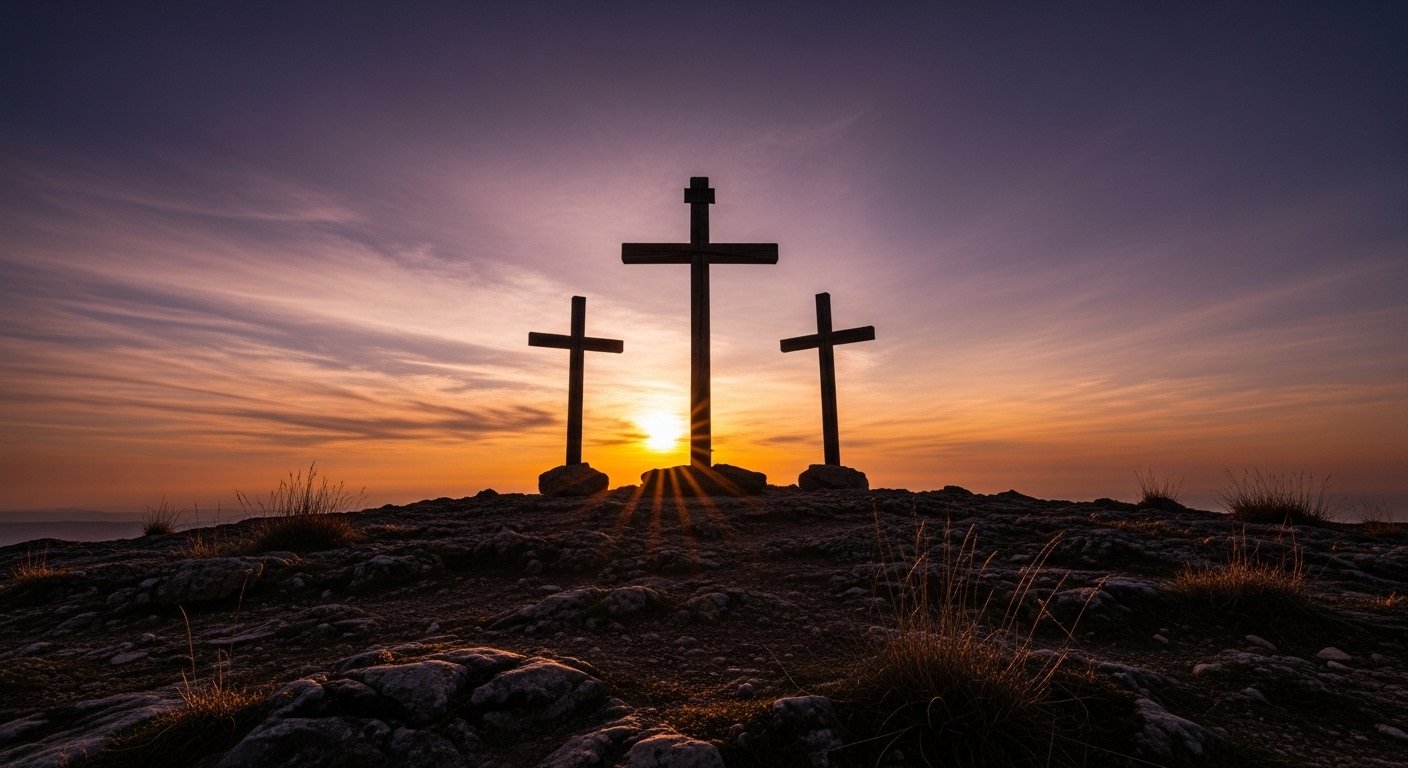
On that cross, three men hung there. Two thieves and the Son of God.
And we indeed justly, for we receive the due reward of our deeds: but this man hath done nothing amiss. And he said unto Jesus, Lord, remember me when thou comest into thy kingdom. And Jesus said unto him, Verily I say unto thee, To day shalt thou be with me in paradise.
Luke 23:41–43 (KJV)
In one sense, the scene does not remain confined to that hill. We remain as the thieves hanging on the cross, mortal, guilty, passing, and faced with the King on the cross. It continues as a present reality. Each response is still before us: to reject and remain under judgment, or to turn and receive, no in between. The thieves reflect the condition of humanity, fully responsible for their sin, yet with Christ present as the only hope, with the promise of paradise.
As the hours pass, Jesus speaks from the cross, and His words reveal the depth of what He enters into: judgment-bearing sorrow, standing in the place of the guilty.
And about the ninth hour Jesus cried with a loud voice, saying, Eli, Eli, lama sabachthani? that is to say, My God, my God, why hast thou forsaken me?
Matthew 27:46 (KJV)
When Jesus therefore had received the vinegar, he said, It is finished: and he bowed his head, and gave up the ghost.
John 19:30 (KJV)
Tetelestai, “It is finished”. The word carries the sense of completion with lasting effect, a work completed in that moment with results that continue. In its original context, it marked a debt fully paid, settled in full. It also speaks of a task brought to completion, a responsibility fully carried out. On the cross, it declares that everything necessary for our redemption has been accomplished.
Blotting out the handwriting of ordinances that was against us… and took it out of the way, nailing it to his cross.
Colossians 2:14 (KJV)
I have glorified thee on the earth: I have finished the work which thou gavest me to do.
John 17:4 (KJV)
So when Jesus says, It is finished, He is declaring that what was given to Him by the Father has been fully accomplished, with nothing left outstanding.
He is pierced on His sides, the Lamb is slain, and the blood is shed, in accordance with what Scripture has established concerning remission.
The Burial
After the cross comes the grave. The body is taken down, wrapped, and laid in a tomb, and the stone is set in place. The work of Friday has been done in blood and sorrow. The city that had shouted crucify Him now quiets, and the disciples are scattered, grieving, confused, and afraid. Heaven seems silent.
Because there is a holy pause in the story.
A Sabbath stillness settles over all things. A day when the earth holds the body of the Lord, and all appears ended. The King is in the tomb. The Lamb has been slain. The blood has been poured out. The words “It is finished” still hang over all things.
And then comes Saturday.
Shhhhhhhhhhhhhhhh.
We leave the story here for now, at the grave, at the silence, at the waiting.
More grace as you continue to bless lives. God bless you Ini.